


You can focus on these topics in this multi-part series on "Microsoft Teams" to look forward to:
- How the "Hub for Teamwork" has developed in the first 2 years,
- What opportunities and challenges you encounter in the enterprise environment in customer projects and
- How these are addressed in a targeted manner.
In this second article, you will receive a variety of tips on what needs to be considered and taken into account for a successful introduction of Microsoft Teams in your company.
Absolutely, Microsoft Teams is fun and offers many great opportunities in the area of collaboration and communication. Microsoft is also constantly investing in the further expansion of this Office 365 service. Top!
The appetite on the company side has been awakened - especially in the business and user area - many ideas and possible potentials are floating around. Now it has to happen quickly... The desire (or pressure) from business users and management on the relevant IT managers is high to make the ingenious "tool" available to the entire workforce quickly so that everyone can "simply" use it.
Activating Microsoft Teams and the many highlights and possibilities are made seductively easy. Basically, many new features are already activated by default without having to do anything. Every user can create, invite, change, delete and test Microsoft Teams at will. Cool, right? Or not?
Typical behaviors with Microsoft Teams
In my personal experience and perception, there are different ways in which companies deal with this request.

- Company "Fast&Furious" rolls out Microsoft Teams and briefly informs users that it is now available. Everything else is left to the users.
- Company "Listen&Block" is afraid of the complexity of Microsoft Teams based on hearsay and half-knowledge and therefore does not want to take any further steps at the moment.
- The "Think&Act" company provides competent information and uses the important key points and artifacts to make the introduction a lasting success.
Obviously, I am simplifying and polarizing with this list. There are many factors (culture, budget, resources, technical environment, etc.) that play important roles. Nevertheless, these stereotypes reflect general attitudes towards Microsoft Teams that I observe time and again in companies.
However, there are also aspects that occur independently of the behaviors and often become decisive factors for or against the use of Microsoft Teams. In the following, I will therefore focus on the general challenges that affect every company.
What challenges arise when introducing Microsoft Teams?
At this point I would like to tell you: no problem, the thing runs by itself. Such a great tool can only inspire!
Unfortunately, this is not the case. But if you are aware of this, nothing stands in the way of successfully using Microsoft Teams. The challenges that often arise can generally be divided into 3 main areas:

Being aware of these areas and actively identifying and involving those responsible for the respective domain is an important step in becoming familiar with Microsoft Teams.
You can use the following checklist to identify gaps in the organization around Microsoft Teams and address the most important issues in the various areas:
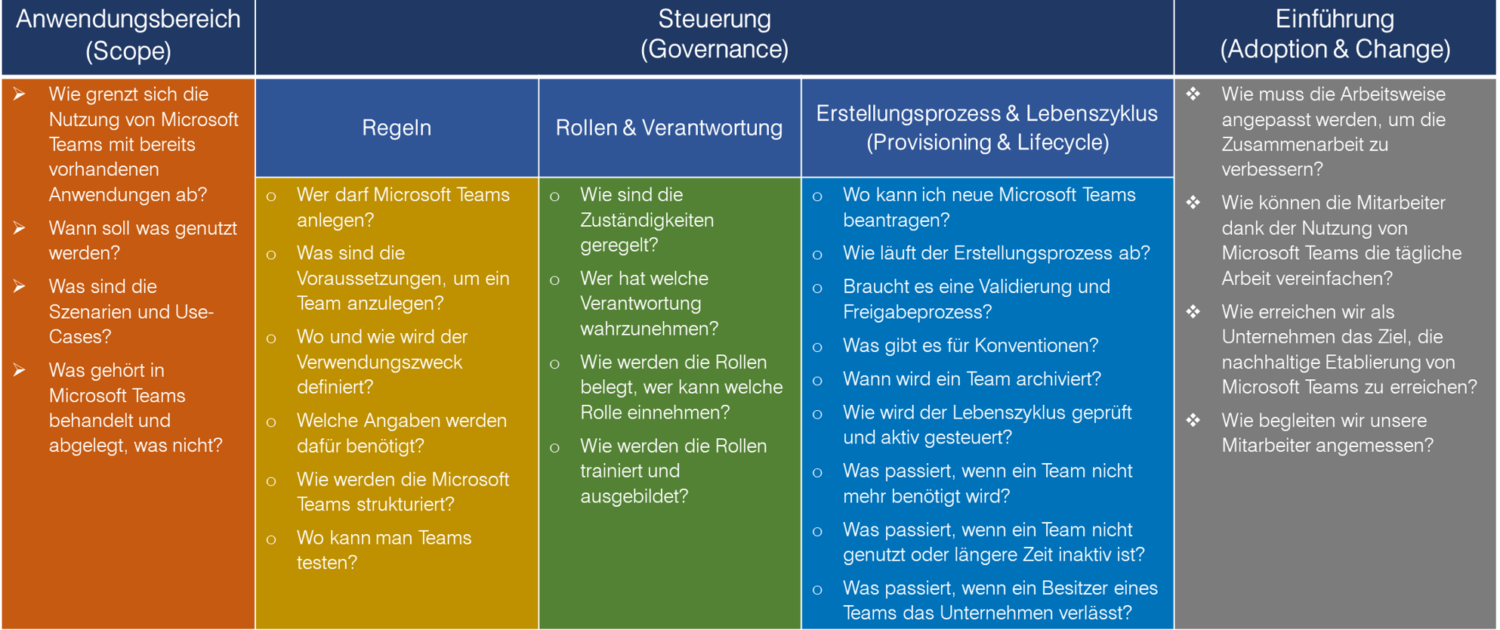
Unfortunately, many companies fail to think about these important issues and clarify the relevant questions BEFORE introducing Microsoft Teams. In addition, Microsoft does not offer any tools or checklists to manage governance appropriately. Awareness of potential problems is therefore rather low in advance.
I hope that this checklist will help you to overcome some of the obstacles. The next part in this series will take a closer look at tools and solutions for successfully introducing Microsoft Teams.
How are companies doing in the meantime "Fast&Furious" 6 months after the rollout?
The situation from the user's point of view:
- The Outlook address book is overloaded with countless Microsoft Teams mailboxes, and nobody knows exactly who is behind them and whether they are needed at all...
- The boundaries to other / already existing tools and services in the company are unclear and everyone is somehow involved without knowing when to use what.
- Countless teams have only been created for test purposes and will never be deleted again. Because nobody dares to delete a supposed "test team". After all, the content could be business-critical.
- The lack of rules, conventions and training leads to a lack of clarity, untraceability of teams and great dissatisfaction among end users.
- There is a high risk that business-critical content will also be viewed by external persons, as the team members are not aware of external access.
- User acceptance suffers greatly and confusion arises
The situation from an IT perspective:
- "We have no control, everyone does what they want!"
- There are various Office 365 objects "buzzing" around for the respective Microsoft Teams (or the associated Office 365 Groups), which are generated unconsciously (SharePoint Site, Planner, Power BI, Yammer Group, email address, calendar...). Chaos!
There is a lack of control options with Microsoft Teams that make it easy to ensure the creation of new Microsoft Teams, the ownership of Teams (even in the event of an employee change) and the lifecycle of Teams.
Conclusion:
- Nobody is really happy.
- Adoption leaves a lot to be desired.
- Users and IT are frustrated.

In the next articles in this series, I will provide you with solutions and tools that can be used to make the introduction a success. We will also take a look at how "Think&Act" companies are doing in the meantime.
By the way: Company "Listen&Block" has still not taken off. The company is proud that it did not take a quick shot with the associated mistakes, but is still stuck in front of the starting line...