


Congratulations! You have found one of the most informative series of articles on Microsoft Teams in German! If you were expecting a simple bullet point list, your expectations will be exceeded, because I will be providing you with much more in-depth information. That's why today you will first find an overview of the development and functionality of MS Teams and we will be looking at the learnings together over the next few weeks.
You can look forward to these topics in this multi-part series on "Microsoft Teams":
- How the "Hub for Teamwork" has developed in its first 2 years,
- What opportunities and challenges you encounter in the enterprise environment in customer projects and
- How these are addressed in a targeted manner.
In this first article, you will get a general overview and learn exciting background information and goals that Microsoft wants to achieve with MS Teams.
The birth of Microsoft Teams
Just over two years ago, Microsoft began to specifically address the area of the easy-to-use "Hub for Teamwork" - a central application for collaboration and individual or group communication. This was not least due to the strong emergence of Slack on the US market.
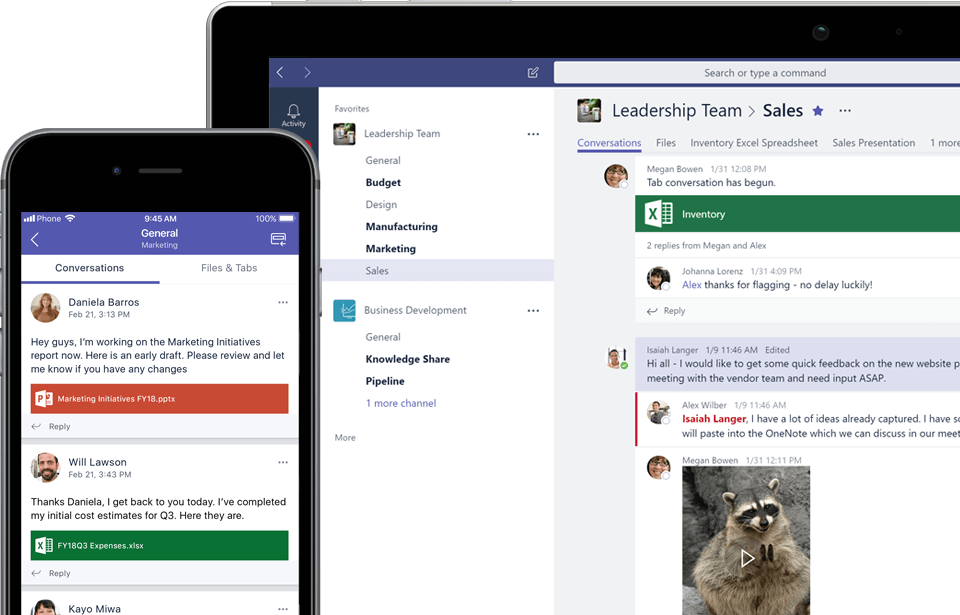
Microsoft Teams enables groups in a company to share information centrally. One of the fundamental goals is to make messages and documents available to all members quickly and easily, thereby digitizing and mobilizing the office space.
Microsoft has been working on the necessary basic technologies and platforms for several years and has bundled them into Office 365 as an innovative collection of online services. I am talking specifically about applications such as SharePoint Online, Skype for Business, OneDrive for Business, Planner & Co.
Logical architecture of Microsoft Teams
In the past, however, there has been a failure to cast these services into a homogeneous, simple application that is especially suitable for millennials and Generation Z and can be used on both desktop and mobile devices.
This important step was taken with MS Teams; also to further reduce traditional communication via email, primarily between employees. Collaboration with people outside the company (suppliers, freelancers, etc.) is also supported smartly and free of charge in MS Teams.
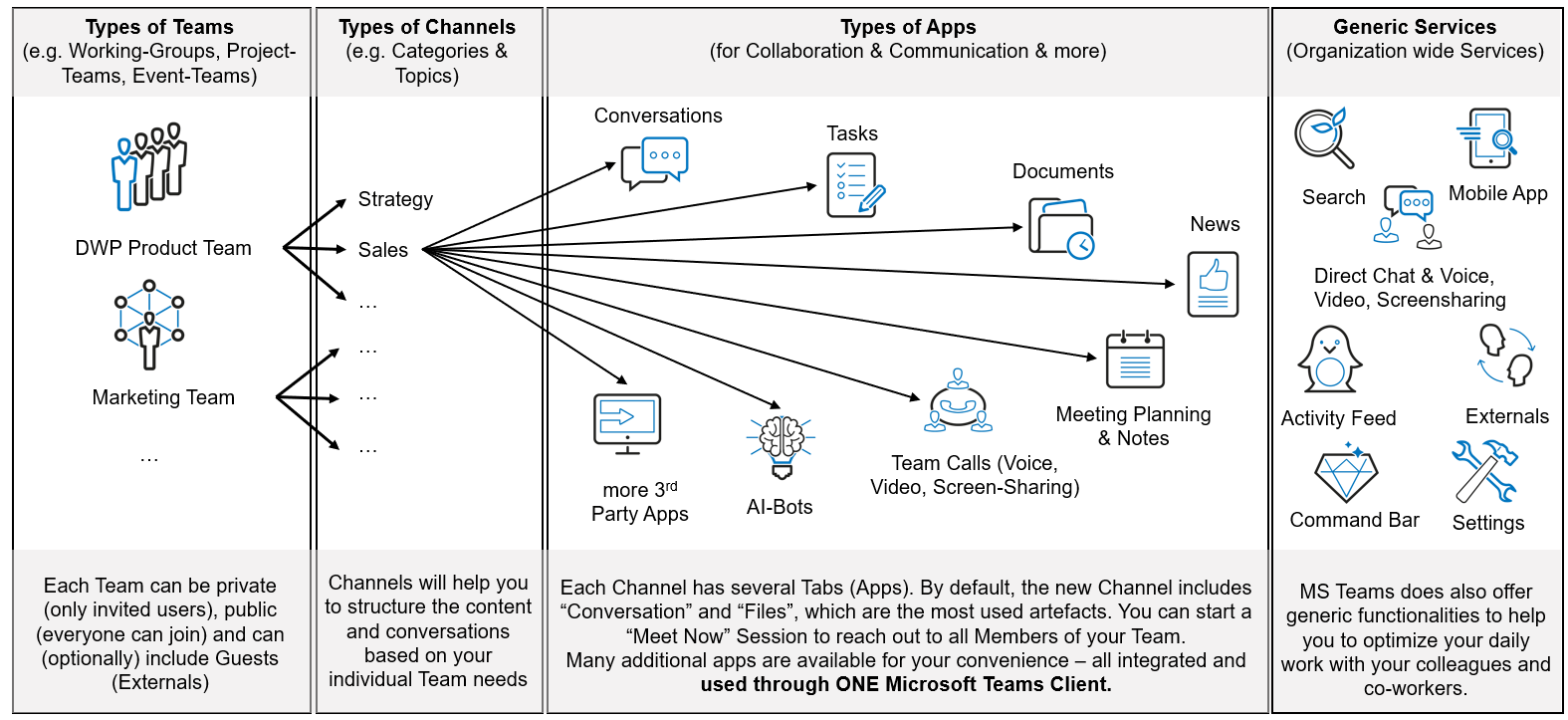
The following figure provides an overview of the logical architecture and structure of MS Teams:
User influence on development & outlook
MS Teams is an online service with a client application and is constantly being expanded and developed in line with customer requirements. As with all current Microsoft services, corresponding suggestions and requests for functionality can be published in the UserVoice community. These can be evaluated and approved by other users. It is also interesting to note that no fewer than 4 of the current top 5 suggestions relate to missing functionality in direct comparison to Slack.
In August 2018, Microsoft announced that "Microsoft Teams" would become the primary service and client for communication and replace Skype for Business in Office 365. The integration of Skype for Business into the Microsoft Teams client is a first significant consolidation that will make the current "parallel world" of the two services disappear. This means that voice and video will be fully integrated into Microsoft Teams, which will certainly increase user-friendliness.
Curious? More about Microsoft Teams
For more in-depth information on the basics of Microsoft Teams, I have listed a few key links on the topic here. All links lead to articles in English and to official Microsoft sources.
- Microsoft Teams Turns 2
- Top 10 Microsoft Teams Questions from Customers
- Microsoft Teams Adoption Guide
- Microsoft Teams Twitter Feed
- Microsoft Teams Blog
What questions do you have about Microsoft Teams? How do you rate the development and practicability of Microsoft Teams? Ask and discuss with us.
As indicated in the introduction, this is just the beginning of a series of our blog on the topic of Microsoft Teams. We will soon be publishing more in-depth articles on the successful introduction of Microsoft Teams, the practical challenges (such as in the areas of business cases, compliance, governance and adoption) and how you can tackle them.