

Many companies are faced with the challenge of keeping employees up to date with the latest information, enabling a flexible way of working and being effective at the same time. However, due to the anticipated expense, innovations in digitalization and the integration of the workplace are progressing slowly.
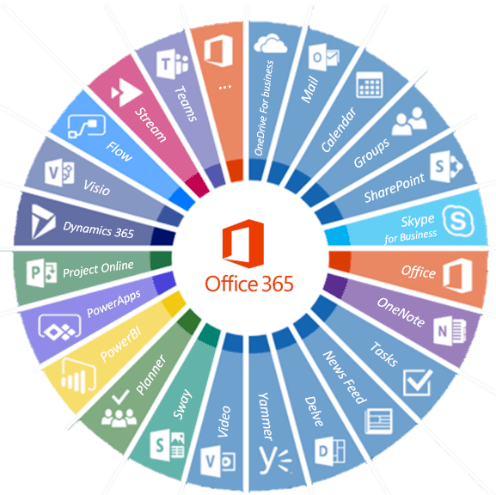
Within the Office 365 suite, Microsoft offers a wide range of options for implementing the digital workplace:
Traditional services such as messaging (email, chat) and classic communication (telephony, video conferencing) but also many services in the area of productivity: collaboration, planning, task management, video portal, office for content production - the list goes on almost endlessly.
The Office Circle provides a good overview:
This article highlights important aspects of collaboration (teamwork) and intranet (communication) as well as the connection of relevant systems to the "digital workplace".
What do the individual areas contain?
Collaboration (teamwork)
The Collaboration area enables members of a working group or project team to work together on project results, plan an event, process the relevant information together, track the status of work at any time from anywhere and spontaneously exchange ideas.
Intranet (Communication)
Thanks to an intranet, you can publish news and information, introduce departments, teams and people, provide official documents and templates, describe work processes and much more.
Connection
In practice, Microsoft technologies are very often used for the implementation of collaboration and intranet. The appropriate platform for this is Office 365. The two areas can be linked in a complementary way using various common elements and, with the connection to company-specific peripheral systems, they can be expanded into a complete digital workplace.
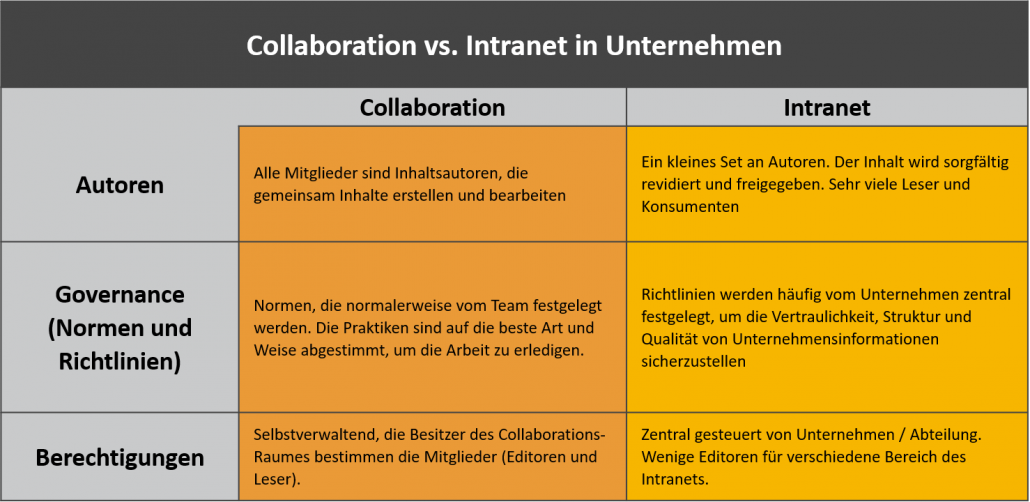
There are other important distinguishing features that are very important for the company, primarily from an organizational perspective. The following table summarizes these; depending on the company structure, you may maintain a collaboration culture or an intranet.
The similarities between the digital workplace and intranet
In practice, the intranet - or rather the digital workplace - is often a combination of intranet (communication) and teamwork (collaboration) and therefore has many connecting elements.
The two central parts - the intranet and the collaboration elements - are given a common design, a superordinate, intelligent search and central, dynamic navigation. The individual components also have dedicated tasks to ensure a smooth workflow.
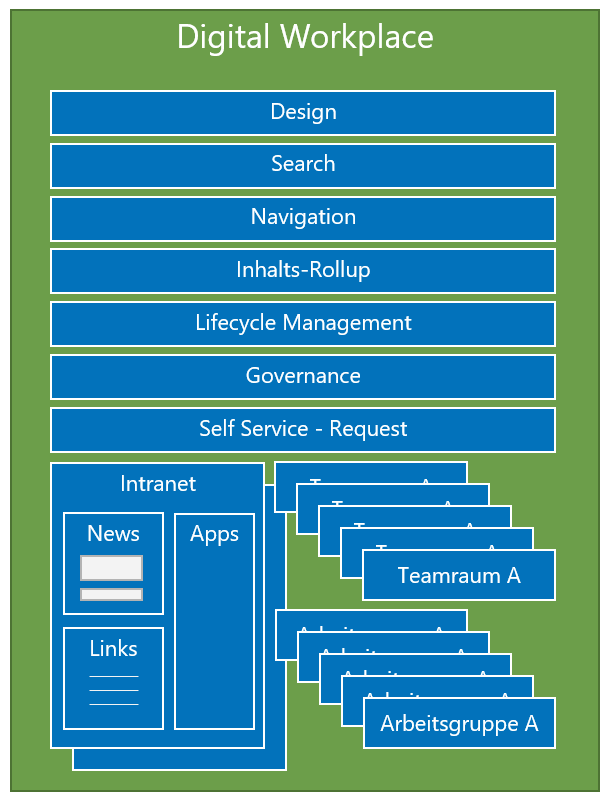
Shown as a content rollup in the illustration, content from all parts is often aggregated (news from different areas, current project rooms where an employee is a member, list of tasks from all areas).
The life cycle of content and workspaces (who is responsible, when does content need to be updated, when is content archived or deleted, etc.) is of great importance in order to ensure quality, hygiene and regulatory (internal and external) requirements.
Governance, especially with regard to content, is of great importance in the intranet sector. Every piece of content needs an owner who ensures that the content is correct and up-to-date. If this owner leaves the company or changes role, the system must indicate that a new owner is being stored. A good system also helps to notify owners when content may be out of date or for which content a person is responsible.
And last but not least, a self-service area. Here, employees can easily request new project rooms, which are automatically provided (with or without an approval process).
All of these components contribute to a balanced and effective workplace that enables users to work independently and as part of a team in equal measure. The digital workplace should become a priority in modern companies in order to promote innovation and retain talent in the long term.