

Following my last post on the opportunities and risks of the cloud, I will now turn to the practical implementation and, above all, the management of the cloud. Cloud governance is a term that can be heard in many places these days. But what exactly is cloud governance?
Cloud governance is about the comprehensive management of a cloud solution. This involves both IT-specific handling and business-related contact points.
Sounds complicated? But it's not really. Think of it like cooking a dish: you need to decide exactly what you want to cook, what ingredients you need, how you want to cook it and when it's ready (or whether you want to expand/refine the dish, etc.).
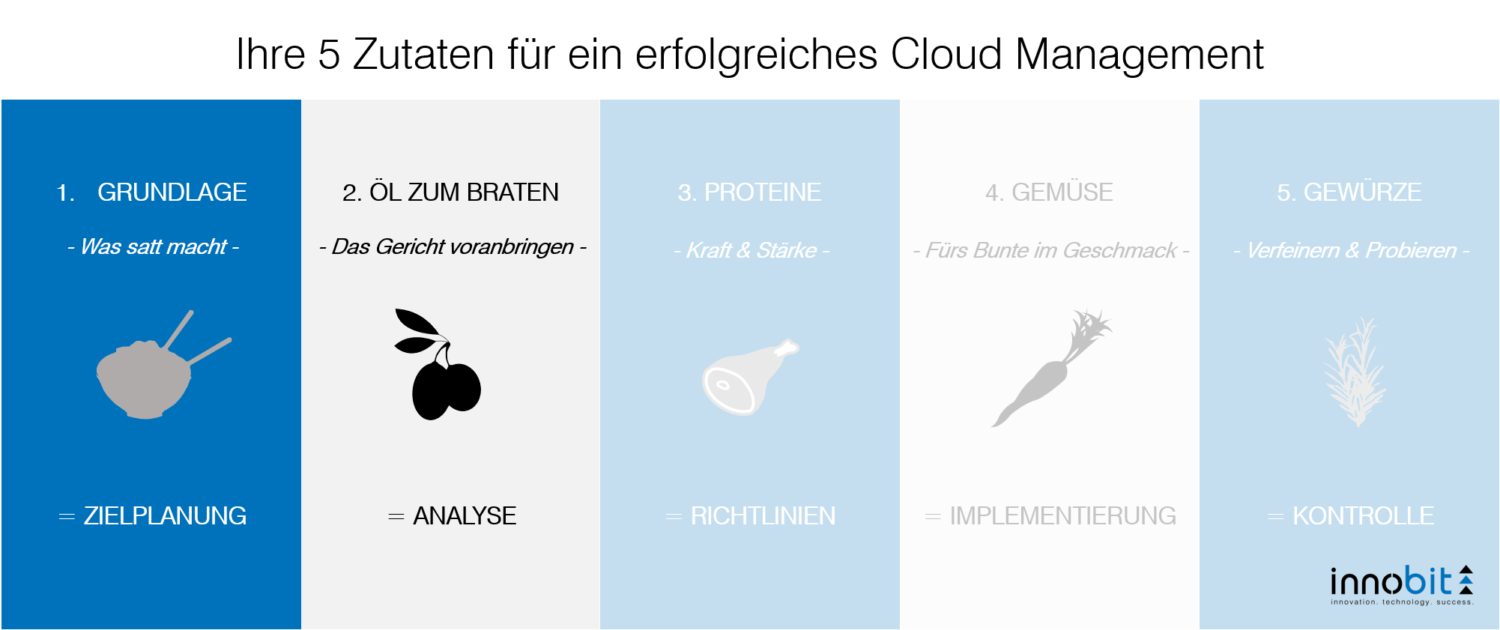
When applied correctly, rules and procedures are defined for the use and implementation of the cloud. Both digital aspects and your employees need to be included.
So that you know what to expect, I have prepared your cloud governance recipe with 5 'ingredients'. Voilà!
Ingredient 1: Basis (= target planning)
The first step is to determine to what extent and in what form a cloud solution is required. There are various options here, be it in the form of Infrastructure as a Service (IaaS), Platform as a Service (PaaS) or Software as a Service (SaaS). Depending on your choice, a corresponding number of services are taken over by the cloud provider of your choice. In this regard, it should be noted that the more services your provider offers, the less control you will have.
Once you have made this decision, the next factor is the desired scope of your cloud implementation: Is the aim to move the company as a whole to the cloud, or is it intended to move individual departments or just individual applications to the cloud?
Example: The company AgileOMs has been planning to move to the cloud for some time. Now the time has come, the decision-makers come together and design the desired implementation. AgileOMs decides to take full advantage of new technologies and move its infrastructure from on-premises to the cloud.
Ingredient 2: Oil for frying (= analysis)
This ingredient of successful cloud governance includes a careful analysis of the characteristics of the cloud solution you are looking for. A fundamental aspect is determining which offer best fulfills your desired scope. Which functions and services are required? What can be dispensed with?
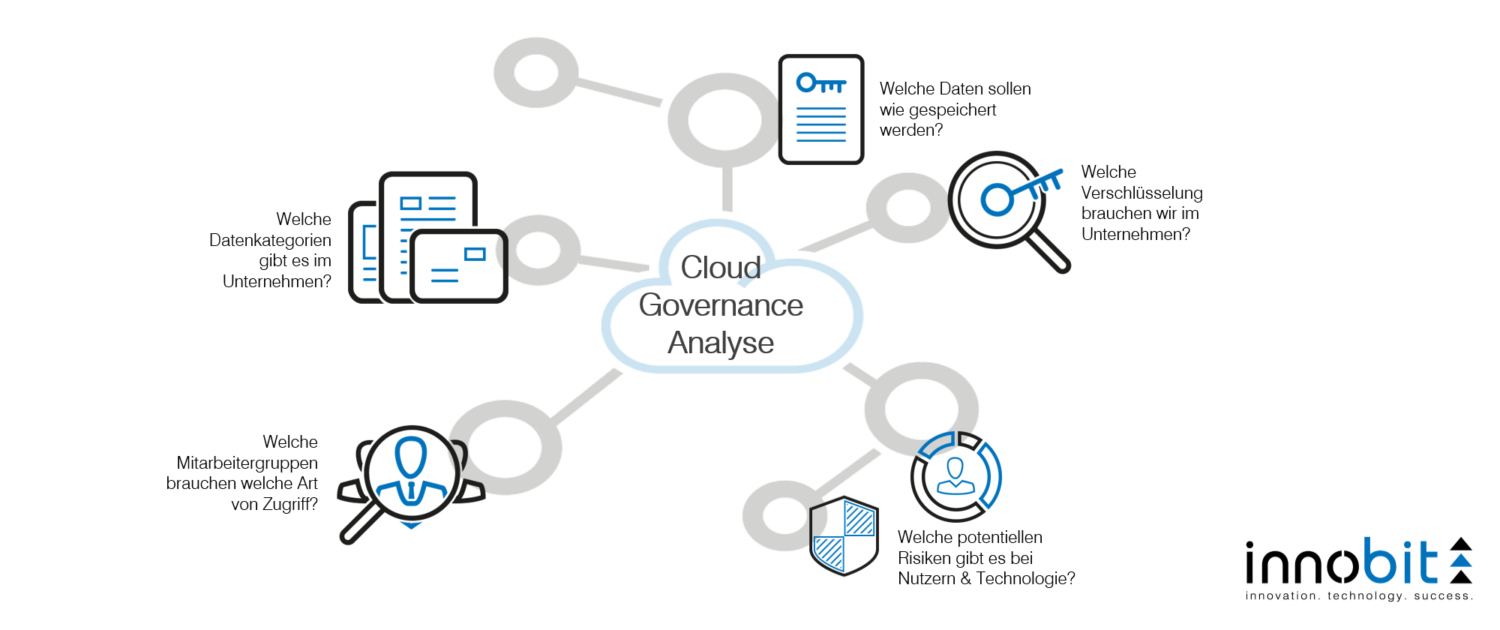
The extent to which resources are required must also be taken into account. Once again, there are numerous alternatives in this context. It is also important to analyze your data landscape and the associated compliance conditions: To the extent that data is categorized according to confidentiality and urgency with regard to your company's operations. This allows you to determine which data needs to be secured in which way and which encryption measures need to be taken. Furthermore, potential risks must be identified, based on the technology as well as the employees and other parties involved.
As you will have noticed, this is an extensive process. Accordingly, it is highly recommended that you enlist the expertise of a cloud consultant you trust.
Example: AgileOMs enlists the help of innobit ag to ensure that the analysis and the rest of the process are professionally designed. The exact requirements for the cloud solution are then determined together. As AgileOMs operates in the healthcare sector, data security is a paramount concern. As a result, the data is categorized according to encryption and backup requirements. Structured access authorization is also required. The requirements can also be defined in the context of the desired infrastructure.
These first two 'ingredients' require a lot of input, knowledge, time and planning. They are the cornerstone for the further development of the 'dish' and are therefore essential for smooth cloud management.

In order to guarantee adequate implementation, it is important that business and IT act as a single unit. This is the only way to find a cloud solution that offers smooth administration by IT in the long term and at the same time covers all the needs of the business.
You will find the other ingredients in the second part of this recipe - bon appétit!
Get to the bottom of this topic with us. We will provide you with non-binding advice on your cloud requirements and all questions relating to the digital workplace. Get in touch with us and conveniently register for a consultation with one of our experts according to your availability - we look forward to hearing from you!