


One of the most striking advantages of the cloud is its scalability: the required scope can be expanded or reduced without great effort. At the same time, the cumbersome operation of hardware solutions such as servers associated with on-premises solutions is no longer necessary. End users are also quickly convinced: data is easily available from different locations as well as from different devices.

It's almost tempting to say: "Switch to the cloud and you'll be rid of all your worries!" Almost. As convincing and strong as the arguments in favor of the cloud are, there are still risks. However, as these often lie in internal structures, they can be controlled as soon as you are aware of them. Possible obstacles can often even be turned into advantages and opportunities. See for yourself!
1st opportunity: Cost structure
A major advantage of the cloud is the flexible adaptation to resource surpluses or resource shortages. With on-premises solutions, you have to buy additional hardware as soon as you need more resources. This can lead to high investments at certain points. However, if you have unused resources, you can only reduce costs to a limited extent. The cloud increases the usability of your infrastructure without incurring significant additional costs or sacrificing security.
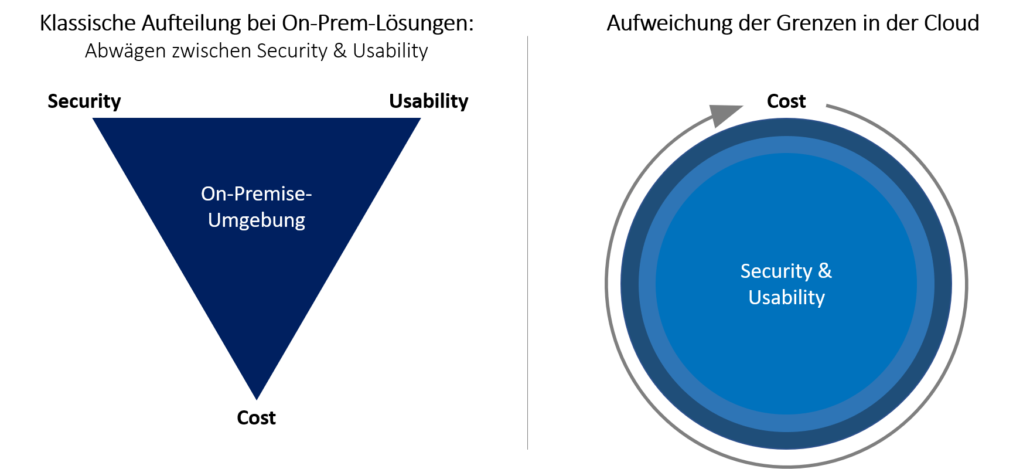
Unfortunately, the cost structure of the cloud is not always easy to understand. If the initially calculated scope of benefits of the cloud is underestimated, this can lead to a drain on resources and impair business operations. An overly generous estimate of the required resources, on the other hand, leads to disproportionately high costs. According to a Flexera study (State of the Cloud 2019), an average of 35% of cloud operating costs could be saved.
Example: DataKing decides to move to the cloud and commissions the internal IT department to do so. The process goes smoothly and the employees are delighted with the newfound agility of the cloud solution. Unfortunately, DataKing's IT department underestimated the use by employees and calculated the resources too tightly. Complaints are quickly received that the usual processes have been slower since the migration: Opening, saving and editing data is delayed. For cost reasons, however, no upgrade can be purchased for the time being, which makes both sides very dissatisfied - the day-to-day working atmosphere deteriorates dramatically. After a months-long hangover, experienced cloud experts are brought in to assess the required resources and plan the budget in the best possible way.
2nd opportunity: Data landscape
Storing data centrally in the cloud promotes collaboration within a team or organization. Access to the data is quick and flexible, as several people can use it at the same time. In addition, the data is no longer tied to one device. If one should crash or run out of battery, the data is synchronized and stored in the cloud. So you won't lose any changes. Your data can also be backed up automatically so that it can be restored if necessary. Similarly, your VMs can also be conveniently backed up in the cloud.

However, there are also stumbling blocks here that you should be aware of. A large amount of data quickly accumulates in the cloud. It is important to define a standardized administration so that it is easy to use and administration remains clear. Incidentally, this is also often overlooked with on-premises solutions.
A clear categorization of data according to confidentiality is essential. If this is neglected, you cannot guarantee the protection of your data. At the same time, additional costs can arise if data is handled and protected as confidential but does not meet this criterion. This is why solutions for organizing and managing data are at the top of many innobit projects.

Example: After DataKing implemented the cloud, its employees continued to use the cloud diligently. The problem of the lack of resources has been solved. However, employees are free to create their own folders and store documents as they wish. Confusion quickly arises: current versions can no longer be found or are filed several times or incorrectly. This leads to a disproportionate amount of data and the usual business processes are also prolonged. Email traffic increases again unnecessarily, as this seems faster and easier. On top of this, there are regular support requests to IT, which also slows down the daily routine.
3rd opportunity: End user & platform
Starting with documents and data, you can go one step further with the cloud and plan projects together. With a cloud solution, your employees can log in and work from anywhere in the world. They can also work on different devices, in line with the motto: Bring your own device (BYOD).
At this point, the challenge of poorly informed end users should be mentioned: Whether intentional or unintentional, the leakage of data or careless handling of access data can represent a major risk for your company, which can have financial and/or legal consequences. It is therefore important that your employees receive an appropriate introduction to the new environment and working methods and are aware of their responsibilities.

Example: After DataKing's IT department introduced standardized naming and management of data in its cloud, everything is running like clockwork. So well, in fact, that employees are fully enjoying the agility and making use of the opportunity to work outside the office. While an employee is sitting in the café working, he urgently needs to use the toilet. Lost in thought, he leaves his notebook unlocked and publicly accessible at the table. Fortunately, no one took advantage of this critical situation; it's hard to imagine what would have happened if someone had copied the confidential spreadsheets he was working on!
How to use all the opportunities of the cloud
You have probably been able to extract the main point of my article by now: Be aware of the potential hurdles and consult experts where additional knowledge is required. A good example is data encryption, which is essential in many industries. Applying multi-level encryption, for example, can lead to delays in transmission as well as in the recovery of lost data. In this respect, it is important to find a good balance between agility and security.

My tip: Guarantee a smooth transition to the cloud environment, then not only you, but also your employees will no longer want to miss the possibilities of the cloud!
Get to the bottom of this topic with us. We will provide you with non-binding advice on your cloud requirements and all questions relating to the digital workplace. Simply register for a consultation with one of our experts according to your availability - we look forward to hearing from you!